

I believe that rather than this being a time and age when the CS skillset is losing its value, it is instead a time when it is becoming more valuable than ever before. Whether we call it software engineering, application development, computer science, or software development, and what attributes you assign to one versus the other, the impact of AI is top of mind for everyone, and for some, it feels like a looming threat.
print('Let me unpack that.')Technology today has made certain projects more approachable and easier to complete, to the point that someone without any formal or, indeed, personal training can quickly put together a software application without writing a single line of code. Security, maintenance, scaling, and hosting costs aside, this is causing a large shift in what the computer scientist needs to focus on to remain relevant.
All of this contributes to raising the bar.
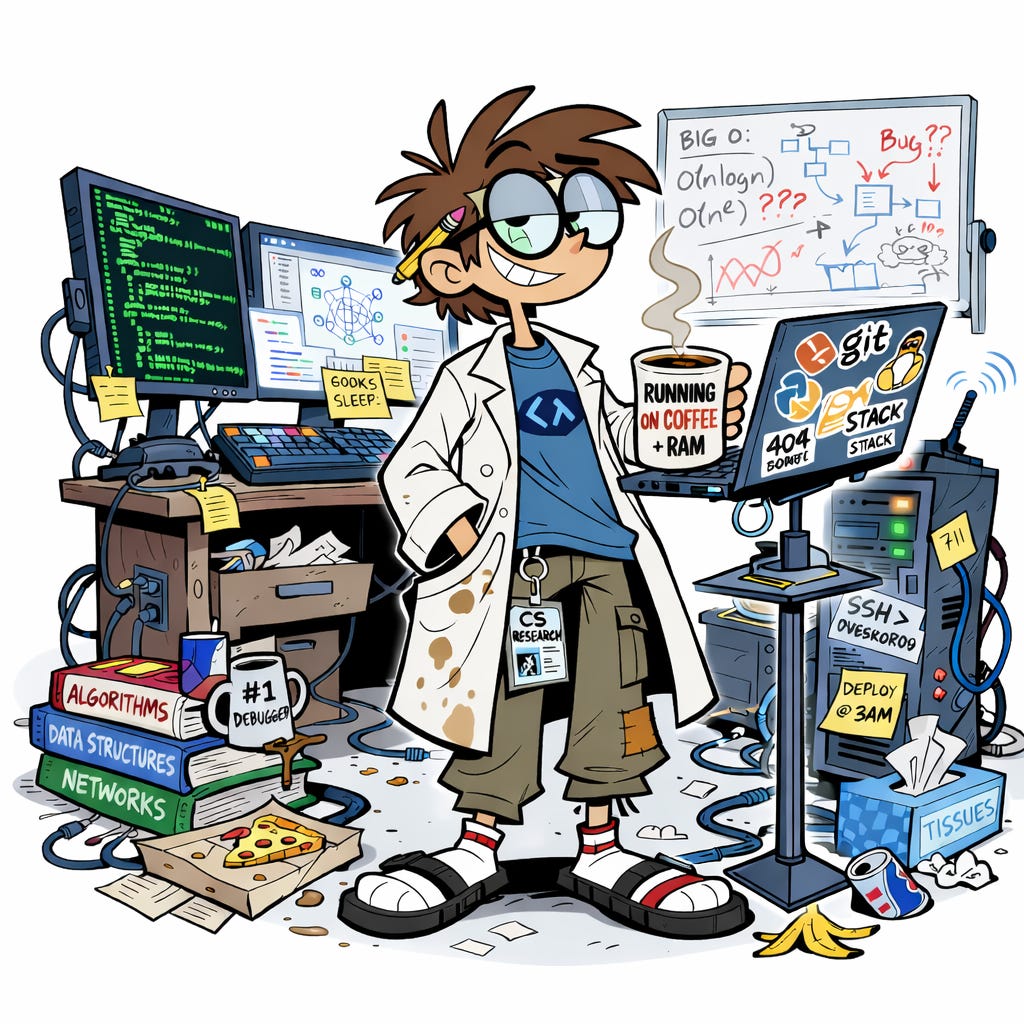
It has happened before. Back in the day, people used to use punch cards to run programs on a computer the size of a silo. A few years later, entrepreneurs were coding websites in their bedrooms and becoming millionaires. Fast forward a couple more years, and anyone could become a cybersecurity expert, deploy an app across all platforms, or launch a game built in Unreal Engine blueprints that could compete in the number of active players with the AAA studios.
Other examples are often encountered out there, such as the industrial revolution, which replaced manual work but enabled many more entrepreneurs and knowledge workers. Perhaps history repeats itself in different forms, and we have to repeat with it by changing our perspective relative to this different form.
We are seeing the next iteration of this progression, where the barrier to entry for simple projects is further lowered. What does not change is the need for expertise for the really complex projects that require research or scale. Regardless of how good technology gets at supporting, even self-sufficiently, the creation of new software, the necessity for human expertise that is able to grasp what is going on, regardless of not having to build everything by hand, will not disappear. It is already the case that software at large companies is an onion built over time by thousands of people. New people coming in that can grasp the system complexity, importance, and its place in the holistic, over-arching software architecture of the company can quickly advance through the ranks.
I believe we will have even more of this. Because without really understanding what you are building, you will be caught off guard as soon as a small thing goes wrong, credibility will be lost, and a lack of expertise will expose you as a fraud. We enjoy how much we can build now; it’s great. But I think we all would acknowledge we wouldn’t want our medical hospital system to be built purely on vibe-coding by agentic systems with a human in control that has no experience with the medical field or a proven record of their character and capabilities. The same goes for the development of airplane control systems, space ships and self-driving cars. We want AI to be the core solution to these challenges, but blindly trusting the end-to-end based on one prompt while assuming responsibility for it is likely to result in failures that will force us to implement the necessary guardrails. This is the reason we have pilots in some of the most advanced machines we have ever built, airplanes. And it is why an LLM will not be piloting it, whilst it might point out a flaw in the manuals, given the records of all crashes in the last ten years.
Moreover, expectations will reset as soon as we can do more complex things more quickly. It will become the new status quo, and we will aim higher, making technology work for us to achieve the new goal. Ten years ago, I was limited by how quickly I could type and figure out the fix to a build issue, rather than being able to focus on the core idea of the project, the differentiating factor, and the technical innovation. Instead, you would be stuck making new pages, an authentication system, and integrating APIs. That is not necessarily smart work; technology will help you now do it quicker. It is work you would find not that engaging to begin with.
How Do I Distinguish Myself?
What you have to do today is to really ponder what it is that you really want to work on. Be open to the answer to keep changing every few years, but make a decision and stick with it for a while. If the answer is computer science, then do not worry about AI replacing you, but instead go deep and do it quickly. Build hard projects that require real knowledge for the choices you make, even if you leverage AI along the way. Make sure you know how to build them, and deploy them yourself, and that you understand why either you or AI have made the architectural decisions you made.
A couple of quick examples could be creating SQLite from scratch, a database system, with indexing, caching, and query engines (check out CodeCrafters.io). These are not an easy feat. You can ask AI right now to make you a starting baseline, and it will, and it would possibly do the entire project in a few prompts, especially since the references exist to open source database system. However, if you are able, with its assistance, to create your own version, with full understanding of all the subsystems, with critical thinking applied to make different choices across the stack (e.g. cache structure, what to support and what not to support, the programming language used, benchmarking and profiling) then you are a software engineer, who has now learnt more than before this project. You would now be more likely to be capable of building it from scratch yourself, limited by time to type and debug, rather than by lack of understanding of the internals.
If you picked a direction you care about, pour yourself into it, leverage the tools also, and you will be needed, because there will always be the potential for you to be more knowledgeable than your competition, as long as you find the power of will to push forward, continuously improve and adapt.
Formal education is tasked with giving you something to build on, but the rest is up to you. You are learning Java, but are you using complex frameworks such as the Play Framework or Spring? You are doing algorithmic C++, but are you trying it out in Unreal Engine or Web Assembly? If you are using Python, have you taken a look at Mojo and understand the differences, alongside being able to critique the plethora of dependency management systems (pip, poetry, conda)? As for JavaScript, try your hand at Web Sockets, Bun, NodeJS, and WebGL.
Algorithmical analysis and the ability to express mathematically the system you are designing do not disappear as soon as one goes to the industry. Performance guarantees, system bounds, and expressing the connections inside a system outside of diagrams are critical skills for the senior professional.
Something as simple as expressing the performance costs of a database system:
Analysing the system reliability of a new system (think site reliability engineering), given how many data centres we have, failure rates, expected reads and writes, what guarantees can we give for a certain number of 9’s availability (e.g. 0.99999):
Character movement in a game based on how performant the computer is (FPS-bound):
Or fine-tuning the large language models that we speak of replacing us, using something like Group Relative Policy Optimization (GRPO):
There’s no escaping the math. It is best to vibe with it, just like with code and the desire to build.
Is It Worth Building a Portfolio?
Yes. Per the previous example with a database system buildout, that can help you understand what it takes to achieve such a feat. Having a portfolio of ten projects that are all apps achieving fairly simple behaviour is probably not the best holistically, but it is as good of a start as any. But challenge yourself, make a game engine, for example, even with AI, you will find that thoroughly difficult, and with no right or wrong choices along the way, just principled choices you will need to form educated opinions about.
Take your projects the extra mile with simple automated builds and tests being run on commit/push/merge with status badges in your READMEs and documentation hosted on GitHub for free.

Use AI to help you describe the structure of your project, generate table of contents for your readme’s and keep them up to date. Make informed choices, and use coding constructs you would not have attempted to code yourself before. Set up a benchmarking system that compares the performance of what you have built to what others have. How many entities can your new game engine handle? How many queries per second on specific hardware can your new database system cope with? What are the limits of the new operating system you have put together?
If you showcase depth of understanding, you will eventually stand out. But recognise you need to internalise that depth yourself and not simply hand over that responsibility to the LLM. At the end of the day, you will have to own your impact, be proud of the type of contribution you bring to the table, and be someone you yourself would hire if you began your own startup and needed someone with a good head on their shoulders who really knows what they are talking about.
Show you care, and show through a project that you can connect to on a personal level, rather than just as yet another prompt I have sent my agents to work on today.
Is Vibe Coding Good or Bad?
It comes back to whether you are or are not becoming a better engineer as you go along. If you are not careful, you will stagnate and only improve as the AI improves, and hence you are not needed. But if you improve alongside the AI, you are a much better team together.
One good question to ask yourself is what happens if someone were to take the tools away from you; could you still figure out for yourself how to solve the problem? This same issue existed before AI with googling when some would not know where even to start if Google went down for as little as an hour. Similarly, today, you can distinguish yourself through the pure level of depth and expertise you showcase while using everything at your disposal to amplify your impact and reach. You have gained a superpower, not a supervillain.
Moreover, vibe-coding just for the sake of saying you are doing it is detrimental, unless the productivity and quality gains are there. Be a critic of the outcomes; you can vibe-code and still look at the code, not only focusing on visual outputs. You can vibe-code more than the final product, focusing also on infrastructure, tests, performance comparisons, generating documentation, automated builds, and deployment.
Do Juniors Have a Chance?
Yes, of course, but it is different from what it used to be in the golden age.

The problem at hand is the bar we had previously set. You would be able to get into the industry with minimal knowledge and a CS degree, and expect the industry to mentor you, allow you to mature on the job, and expect you to learn more as you go along, sometimes not really getting pushed to your limits or being asked to learn too much depth.
The responsibility has shifted more to the juniors now, so they can be better than ever as they head out into the world. Everything they need to do so is readily available, whether formal education has caught up or not yet. But more effort than ever is necessary for the average computer scientist to have a valuable skillset they are an expert in upfront. With that in mind, the tools are at our disposal for understanding even the most complex codebases. Anyone can go into the Unix codebase and begin deconstructing, reverse engineering, understanding, and then replicating in a personal project to show their understanding.
Hackathons, catch-the-flag competitions (cyber), groups, societies, organisations (e.g. IEEE, BCS), open source communities, cloud certifications, cybersecurity certifications, they are all fruitful endeavours for expanding your network, experience and portfolio. Grasp every opportunity you can, in parallel to theoretical grounding and exploration. You do not need to focus on beating the AI; you essentially cannot do that at a specific micro-task, but you leverage it to achieve that much more, as long as, again, you are yourself learning and growing. You are at risk only if you are passing the baton of thinking to an AI entirely.
The junior of today has to be the expert of yesterday. But they also have tools today that the experts of yesterday could only have dreamt of. It is no longer a game of soft take-off into the industry. You must fly high and meet them above the clouds.
Should I Jump Into Research?
If you feel the pull towards it. If you are a student, test out the waters in your final year, discuss with professors and other staff, and attempt something with a group of peers. It can be a very rewarding experience, but it is, just like everything else, not something the value of which everyone will appreciate in the same way.
If you work on your foundational knowledge, you can get into research over time, or dip in and out throughout your career. And if you feel this is your calling at this point, whether you are a student or not, it is as good a time as any to assess if you can make it work, given your circumstances. Just like software engineering will not stop being fruitful if you care strongly enough and continuously push the boundaries of what you are capable of accomplishing, so is the case for research. It is a matter of being able to believe in the direction you are heading towards to put the necessary effort to keep chipping away at what some days will be a rougher quest than you might expect.
TL;DR
I believe that someone who is not pursuing computer science for the sake of computer science can now achieve what only a software engineer could do a few years back. So from that point of view, it is not worth pursuing pure computer science if the goal is to remain at the surface level. But with passion and desire for depth of knowledge, the era of technology is just getting started. The types of roles we need expert engineers for seem to be expanding rather than shrinking. Juniors have the chance to really dig deep and pick a craft that they resonate with. Once the choice is made, go under the surface, aim high, not only in terms of short-term financial goals, but in a long-term knowledge trust fund.
You are not alone, connect with others, build better and greater things, complexity not for the sake of complexity, but because the problem you are trying to solve is complex.
Bring your projects to that next level of quality and push to show expertise, which, if you do not already hold, aim to gain through the project itself. Invest in system design, architectural understanding, performance analysis, multiple programming languages, research-grade structured, ground-in-facts and committed approach, with care and strong ownership.
Your Thoughts and Questions
What are your main concerns with the way things are going, and do you have any specific doubts or beliefs about how we can support those currently studying computer science to face the new reality and the current professionals in industry to maintain their momentum?
Good points, well made Adrian. I think another useful way of characterising the issue is, ask yourself what you can do that a non-expert vibe coder can't?
That's a bit like your point about what would happen if they took the tools away?
What would happen if they raised the price beyond your reach, which will probably happen when #enshittification kicks in?
Similar problem, but the other way around. ♻️